
Japan has launched one of the boldest planetary missions ever attempted — a round-trip voyage to a tiny moon of Mars. The Martian Moons eXploration mission, known as MMX, lifted off aboard an H3 rocket from the Tanegashima Space Center in southwestern Japan before dawn on Tuesday, October 20, Reuters reported. If it succeeds, MMX would be the first to collect samples from Phobos and return them to Earth.
It is a defining moment for the Japan Aerospace Exploration Agency (JAXA) — the first mission built to answer how Mars' two small moons got there.
What happened: MMX lifts off from Tanegashima
The uncrewed spacecraft lifted off at 4:41 a.m. local time Tuesday (00:41 PKT) from JAXA's Yoshinobu Launch Complex at Tanegashima, CNN reported — 3:41 p.m. Eastern Time Monday in the United States.

The launch is also the first interplanetary mission for the H3 rocket. Its 2023 debut ended in a high-profile failure when the second-stage engine failed to ignite, Reuters noted, but the rocket has flown mostly successfully since.

The plan: Mars by 2027, samples home in 2031
MMX reaches Mars in August 2027, then orbits Phobos for roughly three years. A small German-French rover named Idefix will be deployed in early 2029 to scout the surface, followed by two landings and sample collection. The spacecraft heads home in 2030, with the sample capsule expected on Earth in 2031.
JAXA aims to collect at least 10 grammes — a little more than 0.4 ounces, per CNN — from a moon barely 27 kilometers across.
Why it matters: two moons that shouldn't exist
After decades of Mars exploration, scientists still don't know where Phobos and Deimos came from.
"What are these little space potatoes? We can't explain Phobos or Deimos right now. They shouldn't exist, but they do," Dr. Abigail Fraeman, a research scientist at NASA's Jet Propulsion Laboratory in Pasadena, California, and a participating scientist on the mission, told CNN.
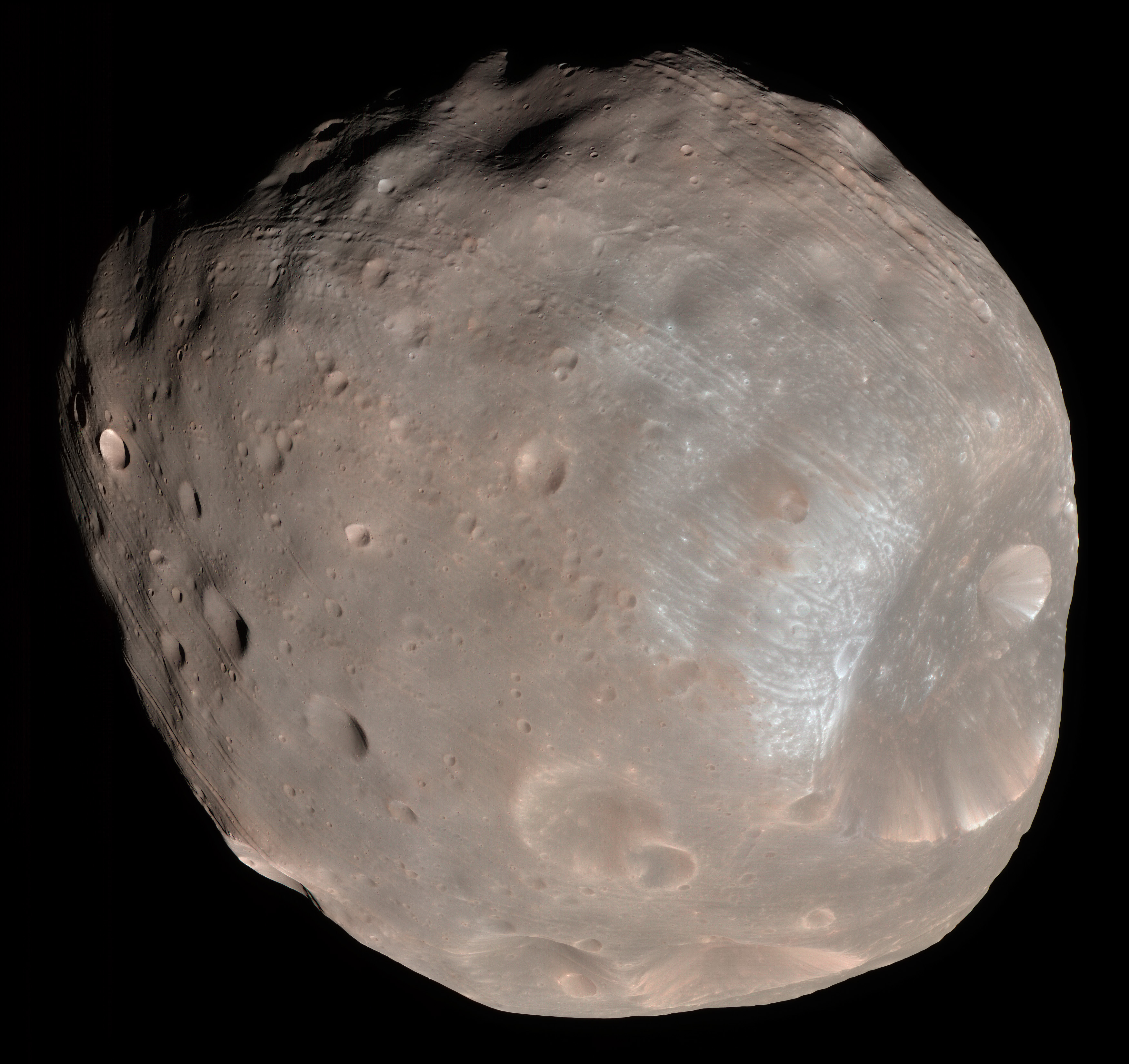
Two hypotheses are on the table: debris from a giant impact on Mars coalesced into the moons, or they are captured asteroids snagged by Mars' gravity. "None of our data fit either hypothesis correctly," Fraeman said — which is why a physical sample matters so much.
"This is kind of like one of the major outstanding mysteries of solar system formation, the origin of Phobos and Deimos, so we really do need a mission like MMX to figure this out," said Dr. Daniel Glavin, senior scientist at NASA's Goddard Space Flight Center in Greenbelt, Maryland, and another participating scientist on the mission.
The samples could also contain pieces of Mars itself. Phobos sits so close to the planet that it acts like a "little dustpan," in Fraeman's words, collecting material swept up from Mars' thin atmosphere. If Martian fragments turn up, MMX could be the first mission to bring Martian material to Earth — in a race alongside China, whose Tianwen-3 mission aims to return Mars samples in 2031, CNN reported.
A world team behind one spacecraft
The Japanese-led mission carries instruments from NASA, the European Space Agency, France's National Center for Space Studies and the German Aerospace Center, CNN reported.
The German-French Idefix rover is one of the mission's showpieces: a drink-crate-sized craft weighing about 55 pounds (25 kilograms) on Earth, to be dropped from 131 to 328 feet (40 to 100 meters) above Phobos. It will effectively weigh about 0.5 ounces (15 grams) there, and its 100-day mission is to scout landing sites.
The lander has two samplers: a corer that drills 0.8 inches (2 centimeters) down, and a pneumatic sampler that uses pressurized gas to kick up surface dust. The team plans to sample both the Mars-facing side and the side facing away, said JAXA scientist Dr. Tomohiro Usui.
Key takeaways
- Japan's MMX spacecraft launched October 20, 2026, aiming to become the first mission to collect samples from Phobos, one of Mars' two moons, and return them to Earth.
- The spacecraft will reach Mars in August 2027 and is expected to bring at least 10 grammes of material back to Earth in 2031.
- The mission's goal is to solve the mystery of how Phobos and Deimos formed — two theories, a giant impact or captured asteroids, and neither fully fits the data.
- A German-French rover named Idefix will scout Phobos ahead of two landings starting in 2029.
- The launch is the first interplanetary flight of Japan's H3 rocket, recovering from its failed 2023 debut.
Frequently asked questions
What is Japan's MMX mission?
MMX stands for Martian Moons eXploration, a JAXA-led mission to Phobos, Mars' larger moon. Launched October 20, 2026, it aims to be the first mission to collect samples from a Martian moon and return them to Earth in 2031.
Why is Phobos important to scientists?
Nobody fully knows how Mars' two small moons formed. The leading ideas — debris from a giant impact, or captured asteroids — both have gaps. A Phobos sample could settle the debate.
When will MMX return its samples to Earth?
Arrival at Mars in August 2027, Idefix rover deployment in early 2029, sample collection during 2029–2030, the journey home starting in 2030, and the sample capsule landing on Earth in 2031.
What rocket launched MMX?
Japan's H3 rocket, launched from the Yoshinobu Launch Complex at Tanegashima — its first interplanetary mission. Its 2023 debut failed when the second-stage engine did not ignite, but it has flown mostly successfully since.
How big is Phobos?
Phobos is a lumpy body about 27 by 22 by 18 kilometers (17 by 14 by 11 miles). It orbits Mars three times a day, roughly 6,000 kilometers (3,700 miles) above the surface. Its defining feature is Stickney crater, about 6 miles (9.7 kilometers) wide.
More from GlobalDeskNews
- China Q3 GDP 2026: 4.5% Growth Beats Forecast on Exports — China's Tianwen-3 mission is racing MMX to bring Martian samples home in 2031.
- Ukraine Accuses SpaceX of Crippling Drone Missions — the growing role of space technology in world affairs.
Sources
- Reuters — Japan launches mission to return samples from Mars moon (October 19, 2026)
- CNN — Mars' two tiny moons shouldn't exist. A new mission has launched to reveal their secrets (October 19, 2026)