
Quick Answer: Iran's Revolutionary Guards said on Tuesday, October 20, that their naval mines hit three oil tankers crossing the Strait of Hormuz through routes Tehran calls illegal. Two tankers were set ablaze, and a third carrying over two million barrels of crude caught fire — but no vessel has been identified and maritime monitors say the claims are unverified.
Iran's Revolutionary Guards claimed on Tuesday that their naval mines struck three oil tankers attempting to cross the Strait of Hormuz along routes Tehran considers illegal, in a dramatic new assertion about the waterway at the center of the months-long Middle East war. The claim marks a sharp escalation in Iran's mine-strike announcements: just a day earlier, GlobalDeskNews reported a single tanker mine strike in the strait. This time Tehran says three vessels were hit. None has been independently identified, and maritime security authorities say the claims remain unsubstantiated.

Three Iranian fast-attack craft approach an internationally flagged merchant vessel in the Strait of Hormuz, in a 2023 U.S. Navy surveillance image. Photo: NAVCENT Public Affairs, Wikimedia Commons, public domain.
IRGC claims three tankers hit mines in the Strait of Hormuz
"Two violating oil tankers were set ablaze and halted due to the explosion of mines planted by the brave sailors of the IRGC Navy at an illegal crossing point in the southern part of the Strait of Hormuz," the Guards said in a statement published on their official Sepah News website, according to Arab News and Al Arabiya, which both reported the claim on Tuesday.
In a later statement carried by Iranian state TV, the Guards added that a third oil tanker "exploded and caught fire after striking a naval mine south of the Strait of Hormuz." The statement said the vessel was "carrying over two million barrels of crude oil, had deactivated all of its radar and navigation systems."
Iran's armed forces chief of staff, Ali Abdollahi, struck a defiant note on Tuesday: "Should the enemy commit any further errors, we will neutralize the impact of their expensive, advanced equipment using a wide array of low-cost yet effective equipment." He said Iran is using cheap weapons to attack expensive American equipment.

The Strait of Hormuz, seen from Oman's Musandam Peninsula. Photo: thy from Bonn, Germany, Wikimedia Commons, CC BY 2.0.
What the claims don't prove
The Guards did not identify any of the three vessels, nor did they provide independently verifiable evidence of the reported strikes. That matters because Iran has a track record of mine-strike claims that fell apart under outside scrutiny.
Maritime publication gCaptain, which follows these announcements closely, noted Tuesday that the Guards also failed to make clear when the first two tankers were allegedly hit — leaving open whether the announcements describe genuinely new incidents or simply repeat earlier claims in new packaging.
The pattern is well documented. On July 18, the IRGC claimed two oil tankers exploded in a minefield in the southern strait; U.S. Central Command rejected that account as false. On August 31, Iranian state television reported a supertanker had struck two naval mines, caught fire and stopped — CENTCOM answered with an unusually direct denial: "No ships have hit mines in the Strait of Hormuz," calling the announcement disinformation. More claims followed on September 2, October 10 and October 12. None, gCaptain reports, established the vessels' identities or produced independent confirmation.
The clearest contradiction came just last week, when Iran said a containership had struck a naval mine — a description matching the Singapore-flagged GFS Pride, which had caught fire and sunk. But the Joint Maritime Information Center's October 15 assessment found the vessel had been struck by an unknown projectile, with no substantiation for Iran's mine claim. CENTCOM went further, identifying an IRGC projectile as the cause and saying the ship sank while being towed toward shore; all 21 crew members were safely evacuated.
A waterway on the edge
The claims landed against a bleak backdrop. The war, according to Arab News, began on February 28, when the United States and Israel launched attacks on Iran that killed the country's supreme leader along with senior military commanders. Since then, Iran has tried to blockade the Strait of Hormuz, demanding all ships seek its authorization to cross — a chokepoint that in peacetime carried around a fifth of the world's oil supplies. Washington has answered with a counterblockade on Iranian ports and ships.
Attacks on vessels trying to cross through a southern route near the Omani coast have picked up in recent days, as Washington pushes to escort more ships through the strait while Tehran fights to control passage. The U.S. says international lanes are open to neutral commercial vessels; Iran insists tankers follow routes it authorizes.
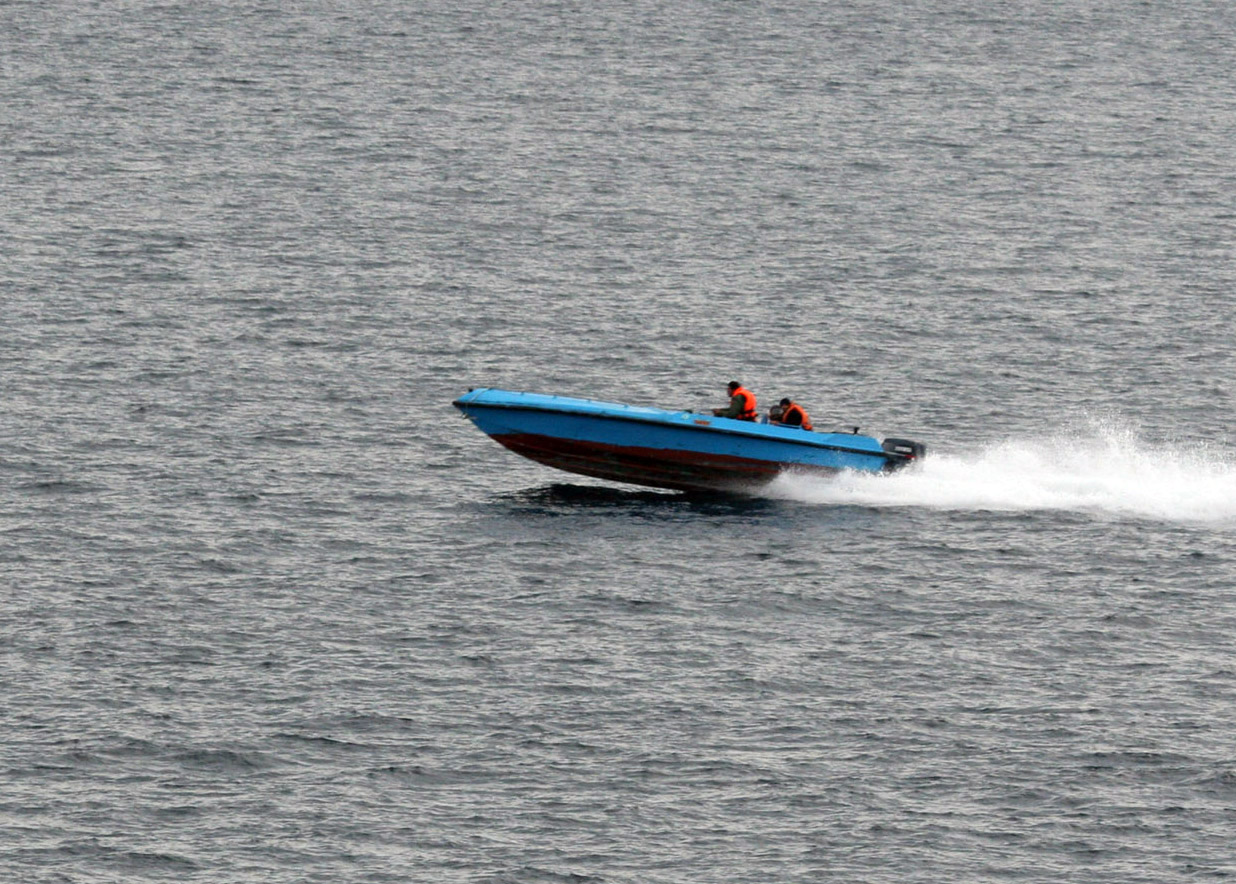
Small craft suspected to be from Iran's Revolutionary Guard Navy maneuver near U.S. Navy ships in the Strait of Hormuz. Photo: U.S. Navy, Wikimedia Commons, public domain.
None of this means the waterway is safe. In March, Reuters reported that Iran had deployed roughly a dozen naval mines in the strait, citing two sources familiar with the matter, and U.S. forces carried out extensive clearance work afterward. In late August, President Donald Trump announced mines had been cleared from the international shipping lanes, a claim backed by CENTCOM commander Adm. Brad Cooper.
But the danger is still real. The Joint Maritime Information Center's October 18 advisory kept a SEVERE threat level for the strait and warned mariners to stay alert for attempted mining inside and near the traffic separation scheme. It documented 153 confirmed maritime security incidents across the wider region since March 1, including strikes by unidentified projectiles, drones and small boats — and noted traffic through Hormuz is running about 70 percent below prewar levels, with 254 vessel transits in the week ending October 14.
Why it matters
For anyone watching fuel prices, the strait's fate is personal. Even unverified claims move markets: December WTI crude jumped more than 5 percent on Tuesday to a five-month high before easing to close down 72 cents (0.73 percent) on hopes for diplomacy, Barchart reported. Goldman Sachs estimates a $24-a-barrel risk premium is baked into crude prices because of the conflict, and shipping oil from the Middle East to China just hit a record $1.4 million a day.
For U.S. readers, the link is direct: when the world's most important oil chokepoint turns into a minefield — real or claimed — gasoline prices feel it. The bigger fear is a verified strike, which would suggest newly laid mines in waters U.S. forces declared clear and could force fresh clearance operations and rerouted shipping.

An aerial view of the Strait of Hormuz from 35,000 feet. Photo: Richard Weil, Wikimedia Commons, CC BY-SA 4.0.
What happens next
Verification will decide everything. Independent ship-tracking data, satellite imagery, or a statement from a ship's owner or flag state could confirm or puncture Tehran's account within days. A fresh CENTCOM denial would be telling — and a confirmed strike would show up in the Joint Maritime Information Center's next advisory, not just on Iranian state media.
Diplomacy is the other thread. An unconfirmed report Tuesday said Qatar and Pakistan had floated a fresh proposal to restart negotiations to end the war, and Barchart noted that hope helped erase crude's early rally. Whether that proposal is real — and whether Washington or Tehran engages with it — will shape the strait's next chapter more than any single claim.
Read also: Oil Tanker Hits Mine in Strait of Hormuz, Catches Fire | Supertanker Hits Naval Mine in Strait of Hormuz, IRGC Claims | Iran Claims Downing US MQ-9 Drone Over Strait of Hormuz | Iran Closes Strait of Hormuz Again After Israeli Strikes
Key Takeaways
- Iran's Revolutionary Guards said Tuesday their naval mines hit three oil tankers crossing the Strait of Hormuz along routes Tehran deems illegal — two set ablaze and a third with over two million barrels of crude that caught fire.
- Not one vessel has been identified, and neither the timing of the first two strikes nor independent evidence has been provided.
- Maritime monitors are skeptical: JMIC found "no substantiation" for the Guards' October 17 mine claims, and CENTCOM has previously called similar claims disinformation.
- Even so, the waterway is genuinely dangerous — JMIC keeps a SEVERE threat level, 153 confirmed incidents have been logged since March 1, and traffic sits about 70 percent below prewar levels.
- Oil prices swung hard Tuesday, jumping more than 5 percent to a five-month high before settling lower on diplomacy hopes.
Frequently Asked Questions
Did three oil tankers really hit naval mines in the Strait of Hormuz?
Only Iran says so. The IRGC announced Tuesday that three tankers struck its mines, but named none of the vessels and produced no independently verifiable evidence. Maritime authorities have not confirmed the strikes, and the Guards did not clarify when two of the alleged incidents happened — they may be new events or recycled older claims.
What exactly did the IRGC say about the three tankers?
The Guards said in a Sepah News statement that two "violating" tankers were set ablaze and halted by mines at an "illegal crossing point" in the southern strait. A later statement said a third tanker, carrying over two million barrels of crude with its radar and navigation switched off, exploded and caught fire after hitting a mine south of Hormuz.
Why does Iran call the tanker route "illegal"?
Since the war that began February 28, Iran has tried to blockade the Strait of Hormuz and demands every ship seek its authorization to cross. Washington rejects that, insisting international lanes are open to neutral commercial vessels. Tehran has repeatedly targeted ships using a southern route near the Omani coast that it does not authorize.
How important is the Strait of Hormuz for oil?
In peacetime it carried around a fifth of the world's oil supplies. Since the war began, traffic has fallen to about 70 percent below prewar levels — 254 transits in the week ending October 14. Goldman Sachs estimates a $24-a-barrel risk premium in crude prices, and shipping oil to China just hit a record $1.4 million a day.
What have maritime monitors said about Iran's past mine claims?
They have repeatedly found no proof. JMIC's October 18 advisory said there is "no substantiation" for the IRGC's October 17 mine claims. CENTCOM called the August claim disinformation: "No ships have hit mines in the Strait of Hormuz." And when Iran said a containership hit a mine last week, JMIC found it had been struck by an unknown projectile instead.
Could this affect gas prices in the United States?
Possibly. Unverified claims about Hormuz already move oil markets — December WTI jumped more than 5 percent on Tuesday before easing. If independent evidence confirms the strikes, it would signal new mines in cleared waters and could push prices higher. Until then, what matters most is whether shippers or Washington produce proof.
Sources
- Arab News — "Iran Guards say three tankers hit mines crossing Hormuz strait" (Oct 20, 2026)
- Al Arabiya English — "Iran says three tankers hit mines crossing Hormuz" (Oct 20, 2026)
- gCaptain — "Iran Claims More Tankers Hit Mines in Hormuz, But Evidence Remains Elusive" (Oct 20, 2026)
- Barchart — "Crude Oil Prices Fall on Diplomacy Hopes to End Iran War" (Oct 20, 2026)
Byline: GlobalDeskNews Staff